

Attendance
Our Attendance Culture at Highters Heath Community School.
School values.
At Highters Heath Community School, excellent attendance is part of our culture of high expectations, belonging and success. Our school values focus on succeeding together, engaging learning, equality for all and aspiring from the start. Regular attendance supports pupils to be ready to learn, to make positive behavioural choices and to take full advantage of school life. It also helps children to build strong friendships, develop confidence and feel a strong sense of belonging within the school community. Being in school consistently gives children the best possible opportunity to thrive both academically and personally. Our behaviour expectations of being Ready, Respectful and Safe complement our attendance expectations: pupils are expected to attend regularly, arrive on time and be ready to learn.
Highters Heath is committed to working in partnership with pupils, parents, carers and the wider community. We recognise that some children face greater barriers to regular attendance than others, so we work with families to understand difficulties, remove barriers and identify appropriate support. Where needed, this can include pastoral support, Early Help and work with local authority or external services.
Regular attendance gives pupils consistent access to Highters Heath's broad, balanced and progressive curriculum, including core subjects, personal development, PE and sport, science, humanities, computing, art, music and wider enrichment. Missing school means missing carefully sequenced learning, classroom discussion, practical experiences and opportunities to build on prior knowledge.
Our school targets - overall and persistent absence.
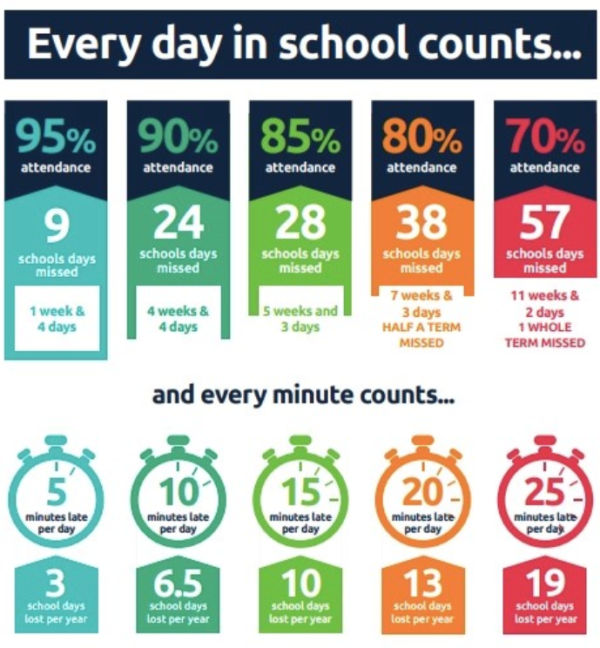
Highters Heath Community School's overall attendance target is 96%. Our aim is for every pupil to attend as regularly as possible and for persistent absence to remain below 10%. A pupil is classed as persistently absent when their attendance falls below 90%.
Impact of missed days over time.
Our Attendance Process.
Time of AM/PM registers.
Morning registration takes place from 8:45am to 8:55am. Pupils arriving between 8:55am and 9:25am will be marked as late. Any arrival after 9:25am will be an unauthorised absence. Afternoon registration is 1:00pm for Reception and Key Stage 1, 1:10pm for Years 3, 4, 5 and 6. The school day ends at 3:15pm for all pupils.
First day calls.
Parents and carers should contact school on the first morning of any unplanned absence and explain the reason for absence and, where possible, the expected return date. This can be done by contacting the school office on 0121 464 2459. If a return date is not known, parents should continue to contact school on each day of absence. Any unexplained absence is followed up promptly by school, which may include a telephone call, a meeting with parents or a safe-and-well visit.
Punctuality.
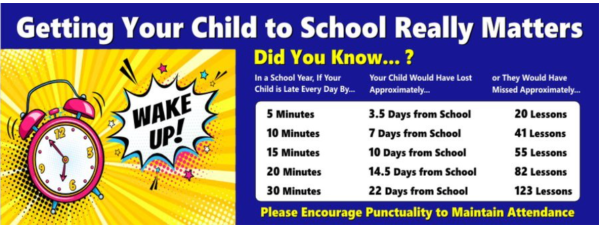
Pupils are expected to arrive at school on time and ready to learn. The morning register closes at 8:55am. Where lateness becomes persistent, school will contact parents and carers so that the reasons can be understood and appropriate support or action can be put in place.
Home visits.
A visit may take place where there are safeguarding or welfare concerns, or where the reason for absence cannot be established. This will be carried out by the senior leadership team. If we do not see a child or hear from parents for a sustained period of time, the school will be required to complete a child missing in education form and submit this to the local authority or we will ask the Police to carry out a safe and well visit.
Leave of absence requests, including DfE expectations.
Parents and carers should avoid taking pupils out of school during term time. Any request for leave of absence must be made in advance, in writing to the Headteacher and, wherever possible, at least four school weeks before the proposed absence. These forms are available from the school office.
The Headteacher will consider each request individually and may authorise absence only where the relevant attendance regulations and guidance allow it. The school's policy identifies examples including participation in a regulated performance or employment abroad, attendance at an interview for another educational setting or future employment, study leave for public examinations, a temporary time-limited part-time timetable, or other exceptional circumstances. A family holiday or leisure trip would not normally be considered an exceptional circumstance. If leave is not authorised and the pupil is absent, the absence will be recorded as unauthorised and may lead to a penalty notice or other legal action.
2026-2027/Attendance-What-will-happen-if-I-book-a-holiday-during-term-time.pdf
Illness and Attendance.
We understand that children will occasionally be unwell and unable to attend school. However, many common illnesses, such as mild coughs, colds, sore throats and minor ailments, do not require children to stay at home. Parents and carers should follow NHS guidance when deciding whether their child is well enough to attend school. If a child is well enough to take part in normal school activities, they should attend wherever possible. For advice on common childhood illnesses and when a child should stay at home, please refer to the NHS guidance.
Common Conditions.
If your child is ill, it’s likely to be due to one of a few minor health conditions. Whether you send your child to school will depend on how severe you think the illness is. Use this guidance to help you make that judgement.
Remember: if you’re concerned about your child’s health, consult a health professional.
- Cough and cold. A child with a minor cough or cold may attend school. If the cold is accompanied by a raised temperature, shivers or drowsiness, the child should stay off school, visit the GP and return to school 24 hours after they start to feel better. If your child has a more severe and long-lasting cough, consult your GP.
- Raised temperature. If your child has a raised temperature, they should not attend school. They can return 24 hours after they start to feel better.
- Rash. Skin rashes can be the first sign of many infectious illnesses, such as chickenpox and measles. Children with these conditions should not attend school. If your child has a rash, check with your GP or practice nurse before sending them to school.
- Headache. A child with a minor headache doesn’t usually need to be kept off school. If the headache is more severe or is accompanied by other symptoms, such as raised temperature or drowsiness, then keep the child off school and consult your GP.
- Vomiting and diarrhoea. Children with diarrhoea and/or vomiting should definitely be kept off school until at least 24 hours after their symptoms have gone. Most cases of diarrhoea and vomiting in children get better without treatment, but if symptoms persist, consult your GP.
- Sore throat. A sore throat alone doesn’t have to keep a child from school. But if it’s accompanied by a raised temperature, your child should stay at home.
- Chickenpox. If your child has chickenpox, keep them off school until all their spots have crusted over.
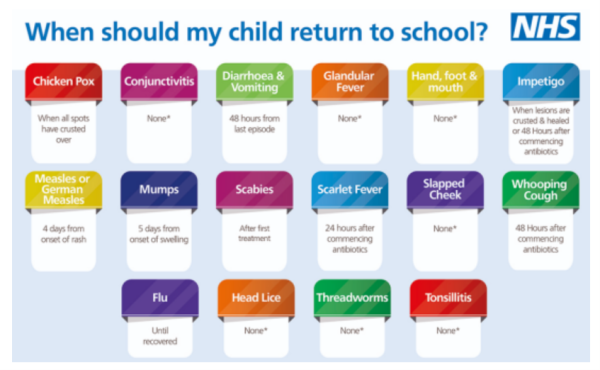
For more information, click on the following link. Is my child too ill for school? - NHS
Elective Home Education.
If you wish to unenroll your child from school and home educate them, parents/carers are required to inform the school in writing. Once we have received your written request, we will follow the local authorities’ procedures and notify Birmingham City Council. We encourage parents to discuss this with the attendance team first so we can explore any further support that can be offered to support your child being educated at school.
Part-Time or Reduced Timetables.
In exceptional circumstances, where a child is unable to access full-time education due to medical needs, special educational needs, or other significant barriers to attendance, a temporary part-time or reduced timetable may be considered as a reasonable adjustment. Parents will meet with the SENCo and a member of the attendance or pastoral team to discuss the child's individual needs and agree to a plan to support access to education. Any reduced timetable will be time-limited, reviewed regularly, and accompanied by a clear plan for a return to full-time education where appropriate. Parents will receive a written agreement outlining the agreed hours, support arrangements, review dates, and expectations for all parties.
The Attendance Team.
Executive Headteacher: Mrs Aulton
Senior Attendance Champion: Mrs Lindsay
Attendance is also supported by the rest of the senior leadership team, pastoral team, class teachers, office staff and the wider Excelsior Multi Academy Trust attendance team.
Early Help and Support.
At Highters Heath Community School, we believe in offering support at the earliest opportunity when attendance concerns arise. We work closely with families to understand any barriers to attendance and identify practical solutions that help children attend school regularly. Our aim is to work in partnership with families, remove barriers to attendance and ensure every child can access their education and achieve their full potential. If you have concerns about your child's attendance, please contact the school office to arrange support. Support may include meetings with the attendance, pastoral or SEND team, attendance plans, wellbeing support, referrals to Early Help services, and signposting to external agencies where appropriate.
How we monitor attendance.
Attendance is monitored closely using daily registration information and regular attendance analysis. School reviews individual pupils, groups and patterns of absence and lateness so that concerns can be identified early. Weekly, half-termly, termly and full-year information is used to identify trends, target support and review the impact of attendance actions.
Parental responsibilities.
Parents and carers are responsible for ensuring that their child attends school regularly and arrives on time, for reporting absence correctly, and for keeping school informed about any circumstances that may affect attendance. Families should avoid unnecessary absence and should not take holidays during term time. If you are planning to do this, you must meet with the attendance team and fill out the request form which is then passed to the Head Teacher who will make a final decision on whether the absence is authorised or not. Where concerns around attendance emerge, school will work in partnership with parents and carers to understand any barriers that may be affecting attendance. This may include offering Early Help meetings to explore the circumstances in more detail, identify appropriate support and agree actions together. Our aim is to support families as early as possible and to do everything reasonably possible to help children attend school regularly and access their education.
Failing to send your child to school regularly and on time without good reason is a criminal offence. Please remember that parental illness, going shopping, visiting sick family members, truancy, not wanting to go to school, alleged bullying (speak to school immediately to resolve the issue) are not acceptable reasons to be absent. All of these will be recorded as unauthorised absence, including if your child arrives at school after the close of registration.
Legal action that may be taken include:
- Issuing penalty notices: Each parent receives a penalty notice for each child who has unauthorised absence. The penalty is £80 or £160 depending on how soon payment is made. So, if there are two parents and three children the total penalties could be up to £960. Failure to pay may result in prosecution.
- Taking parents to court for unauthorised absence: Education Act 1996 Section 444(1) - magistrates can fine each parent up to £1000 per child, add costs and impose Parenting Orders.
- Taking parents to court for persistent unauthorised absence: Education Act 1996 Section 444(1A) - magistrates can fine each parent up to £2,500 per child, impose Parenting Orders and/or impose a period of imprisonment of up to 3 months.
- Being taken to court could result in you having a criminal record.
Nobody wants that to happen. So, remember, every moment your child is in school, they are building their own wall of opportunity. The higher and stronger that wall is, the more opportunities and choices your child will have when they are older, and the more successful they will be in life!
How to prevent your child from missing school.
You can help prevent your child missing school by:
- making sure they understand the importance of good attendance and punctuality;
- taking an interest in their education, asking about schoolwork and encouraging them to get involved in school activities;
- discussing any problems they may have at school and letting their teacher know about any concerns;
- not letting children take time off school for minor ailments, particularly those which would not prevent you from going to work;
- arranging appointments and outings after school hours, at weekends or during school holidays;
- booking family holidays for the school holidays.
Rewards.
Individual rewards.
Each week a random day is chosen by the Headteacher and Senior Attendance Champion. All children who attend on time on that day are entered into our attendance raffle, with a winner being chosen from each class to receive an in-school reward on the Friday of that week. In addition, children who achieve 100% attendance for a term are celebrated in assembly and received a badge and certificate. This helps us recognise and celebrate excellent attendance consistently throughout the year. Children will also receive incentives for improved attendance such as phone calls home by the Senior Attendance Champion to celebrate with parents.
Class-based rewards.
Classes attendance is shared each week in the whole school assembly on a Friday morning. The class with the highest attendance receives a class certificate and the attendance trophy to display in their classroom for the week. If that class has achieved over 96% attendance the class earn an additional ten minutes playtime and if they achieve over 100%, they earn an extra twenty minutes playtime. This promotes wider school recognition of the importance of good attendance and helps to build a positive sense of shared achievement.
Safeguarding and Attendance.
Attendance is both an educational and safeguarding priority. Where concerns arise, school will work with families to understand any barriers to attendance and identify appropriate support, which may include attendance meetings, Early Help, pastoral or SEND support, attendance plans, or referrals to the local authority and other relevant agencies. Home visits will be completed on a child’s first day of absence from school, particularly where there are safeguarding or welfare concerns, and will be carried out by a member of the pastoral or senior leadership team. Where necessary, relevant information will be shared securely with the local authority, other schools and outside agencies in line with safeguarding, statutory attendance and data protection requirements. Workshops and parent meetings will be offered throughout the year to give parents opportunities to discuss any concerns or queries with the attendance and pastoral team. If parents would like support sooner, please contact the office to book a meeting with a member of staff.
Important Documents
Highters Heath Community School Attendance Policy
Good Attendance Matters - Parent Carer Leaflet
Working together to improve school attendance: July 2026
Important Links
BCC School Attendance Advice for Parents